 Soil
SoilWireless Tilt, Temperature & Vibration Sensor
A fully sealed, battery-powered edge sensor that measures three-axis tilt, acceleration, vibration frequency, vibration amplitude and temperature, then uploads event-aware data over NB-IoT or 4G — built for structures where a simple tiltmeter is not enough.
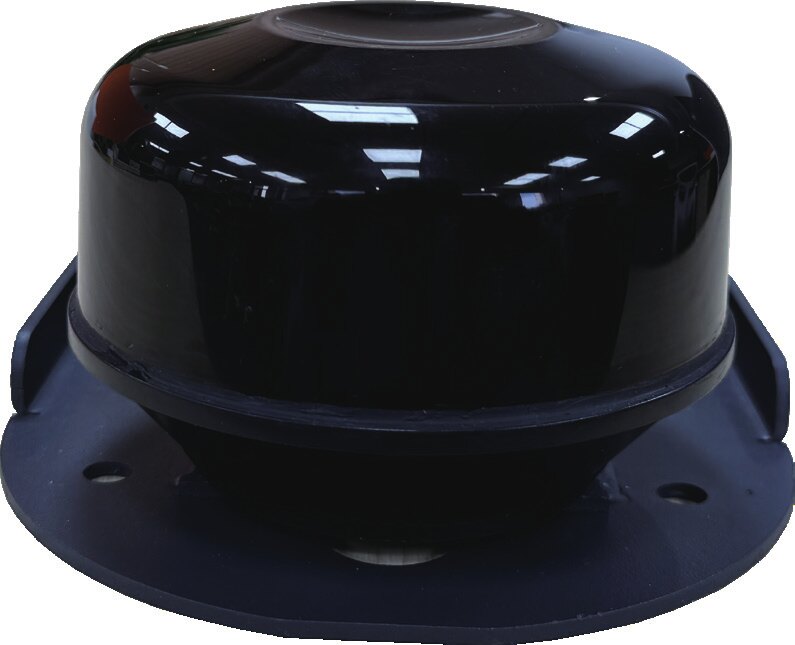
Tilt trend, vibration event and temperature context in one timestamp
SCST-WV02 combines a three-axis MEMS accelerometer, magnetometer, cellular communication, battery power and a sealed polyurethane housing. It reports routine long-term tilt changes, but can also wake on tilt or vibration events and capture high-frequency waveform features for structural health assessment.
- ✓Five measurement elements
Tilt, acceleration, vibration frequency, vibration amplitude and ambient temperature are acquired by one device.
- ✓Scheduled + triggered reporting
Routine low-power monitoring is paired with event-triggered high-frequency sampling when tilt or vibration changes.
- ✓No field wiring
NB-IoT / 4G communication and battery operation fit bridges, towers, slopes and outdoor structures where cabling is expensive or fragile.
- ✓IP68 sealed dome housing
High-strength aging-resistant polyurethane housing with a bolt-down base for harsh outdoor natural environments.
A Low-Power Watch Mode with High-Frequency Event Capture
The sensor normally stays in a reduced-rate watch mode. When scheduled acquisition is due, or when tilt or vibration is detected, it switches to working mode, samples at high frequency and extracts vibration-domain features using FFT.
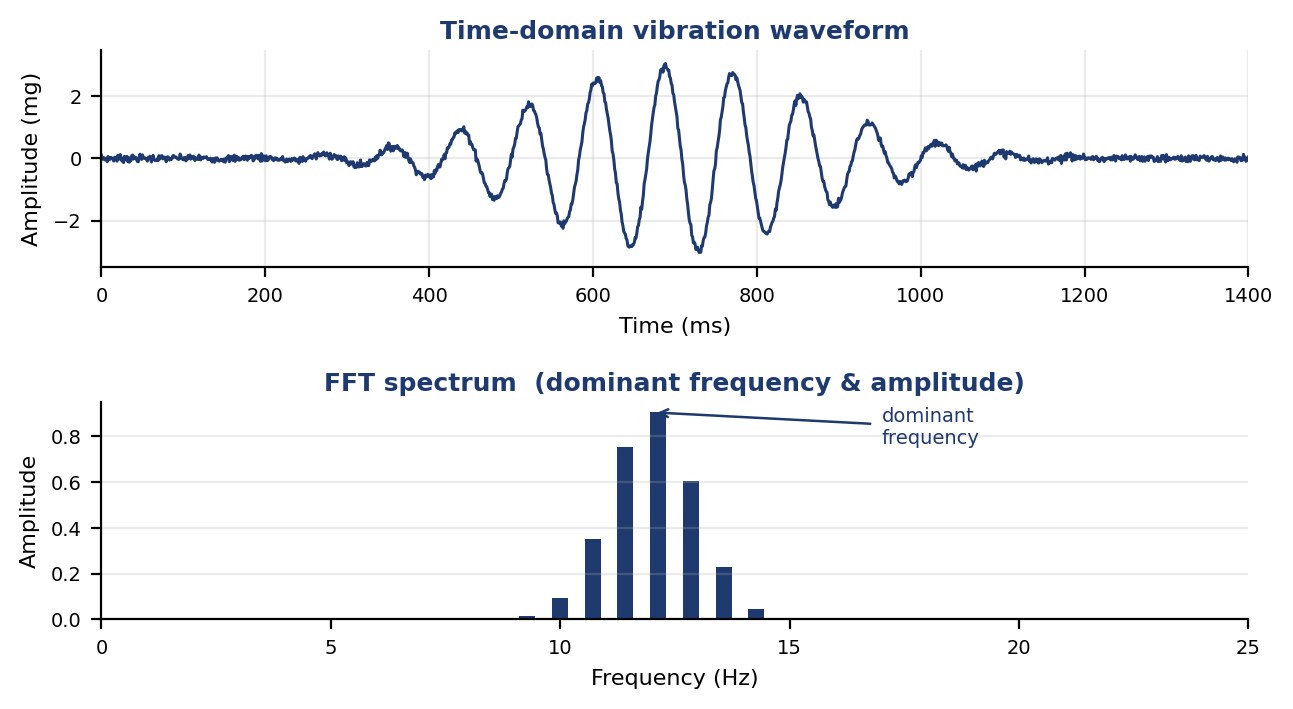
From waveform to usable engineering indicators
For each acquisition period, SCST-WV02 can provide tilt, acceleration, vibration frequency, vibration amplitude, temperature, battery state and position metadata. The cloud platform then binds the data to measurement points, thresholds and project drawings.
- 1Time-domain waveform
Captures event amplitude over time, useful for judging impact, short-term disturbance and vibration duration.
- 2FFT frequency spectrum
Extracts dominant frequency and amplitude, turning raw vibration into structural-health features.
- 3Temperature-linked interpretation
Temperature is recorded with the same device, making it easier to separate thermal effects from true motion.
SCST-WV02 Technical Specifications
The updated SCST-WV02 configuration adds temperature as a measured element, improves acceleration and vibration resolution, and supports NB-IoT or 4G network selection.
| Item | Parameter | Specification |
|---|---|---|
| Measurement | Elements | Tilt, acceleration, vibration frequency, vibration amplitude, temperature |
| Tilt | Range | ±90° |
| Resolution | 0.001° | |
| Accuracy 1 | 0.005° within ±15° | |
| Accuracy 2 | 0.01° within ±90° | |
| Temperature drift | <0.01° (-20 ℃ ~ +50 ℃) | |
| Acceleration | Range | ±2g |
| Resolution | 0.001 mg (1 µg) | |
| Accuracy | 0.01 mg (10 µg) | |
| Vibration | Frequency | Resolution 0.1 Hz; bandwidth 200 Hz |
| Amplitude | Resolution 0.01 mg; accuracy 0.05 mg | |
| Noise density | 18 µg/√Hz (≈0.001 °/√Hz) | |
| Recommended amplitude | Suitable for amplitude above 1 mg | |
| Reporting | Interval | 0s ~ 7200s; default 7200s |
| Communication | Network | NB-IoT / 4G (select one) |
| Interface | Local port | USB-C (configuration & charging) |
| Storage | Onboard flash | 512 MB flash (optional) |
| Power | Battery | Non-rechargeable Li-SOCl2 or rechargeable lithium battery |
| Operating life | Li-SOCl2: up to 36 months at 4 acquisitions/day; rechargeable: up to 12 months | |
| Charging | USB-C, 5 V (rechargeable version) | |
| Consumption | <0.65 mA @ DC 3.6 V | |
| Protocol | Standard | MQTT v3.1.1 |
| Mechanical | Dimensions | Bottom OD 13 cm; height 15 cm |
| Material | High-strength aging-resistant polyurethane | |
| Weight | 1.5 kg | |
| Environment | Temp. / rating | -20 ℃ ~ +85 ℃ / IP68 |
Where SCST-WV02 Adds Value Beyond a Tiltmeter
Choose SCST-WV02 when rotation, vibration and temperature need to be interpreted together, or when a remote point must operate without cabling or external power.
Building Tilt & Vibration
Tracks slow tilt while capturing short vibration events from construction, demolition or traffic disturbance nearby.
Transmission & Telecom Towers
Cable-free tilt and vibration monitoring for unpowered outdoor towers, with IP68 protection and battery operation.
Bridge Tilt Monitoring
Combines pier or deck tilt trends with vibration frequency signatures under traffic and wind.
Slope and Rockfall Warning
Low-power remote points can be deployed on unstable blocks or protection structures where wiring is impractical.
Unattended Outdoor Sites
Sealed housing and cellular upload support long unattended monitoring without sunlight or grid power.
Event-Based Safety Assessment
Dominant frequency, amplitude and tilt change help distinguish normal environmental vibration from abnormal structural response.
Bolt Down, Bind, Set Thresholds
SCST-WV02 is designed for simple civil installation. The important engineering work is choosing a rigid mounting point, binding the device correctly and setting thresholds that reflect the structure's risk model.
Field installation checklist
- 1Install on a rigid structural surface
The bolt-down base must couple directly to the monitored member, not to loose render, tiles or temporary fixtures.
- 2Align the sensitive axes
Mark the monitored direction before drilling; record the initial tilt and installation orientation as the baseline.
- 3Bind network and device ID
Choose NB-IoT or 4G before delivery, then bind the point in the cloud automation-management page.
- 4Set rate and cumulative thresholds
Use control indicators for tilt rate, cumulative tilt and vibration-event alarms per point.
Cloud workflow
- ✓Project overview
Project details, location, stakeholders and remarks are maintained in one project record.
- ✓Monitoring cloud map
Measurement points are placed on drawings or maps, with alarm status visible directly on the project view.
- ✓Data summary & analysis
Tilt, vibration and temperature series can be filtered by time, form type and measurement zone.
- ✓Daily reports and automation status
Automated points feed daily reports and device-status management for O&M teams.
Field Questions, Straight Answers
How is SCST-WV02 different from a normal wireless tiltmeter?
When should I choose SCST-WV02 instead of the tiltmeter series page product?
How long does the battery last?
Does it need sunlight or external power?
Which network should we choose: NB-IoT or 4G?
Can it replace a professional vibration analyzer?
Downloads & Resources
Related Products
Related Cases

Related Solutions

Make an enquiry
Submit your request without leaving the page. Price negotiation stays off the public catalog.
Contact: sales@soilcreate.com · WhatsApp: +86 15356046033